 News & CSR
 Branches
 Contact Us
 Join Us
 Service Complaints
 Customer Portal
The Forklift Price Tag Isn't the Whole Story : Check the Hidden Costs Before You Decide
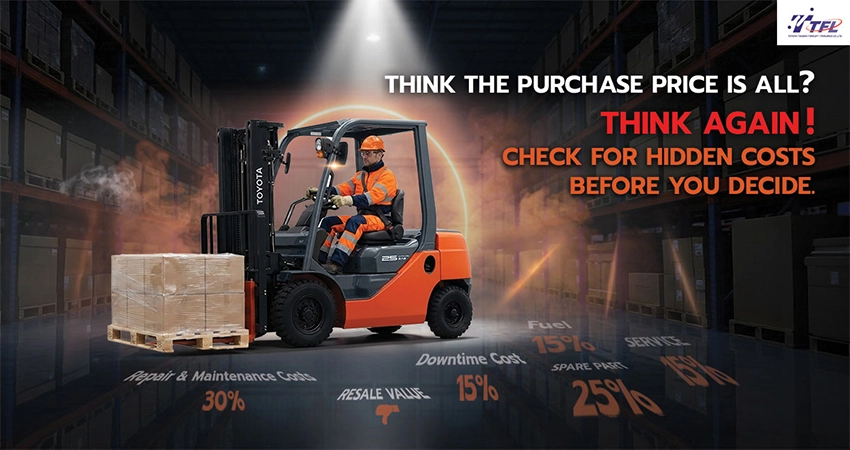
Many businesses choose their forklift based solely on the number on the quote — whichever brand offers a lower price gets the sale. But after a year or two of real use, repair bills, fuel costs, and the hours the machine sits idle waiting for service quickly add up to far more than the initial price difference.
This isn’t unusual. In fact, the purchase price typically accounts for only 20–30% of the total cost over a forklift’s working life. The remaining 70–80% comes from “hidden costs” that are often overlooked. This article walks you through those costs category by category, along with a simple way to calculate them so your next decision delivers real long-term value.
Understanding Total Cost of Ownership (TCO)
Total Cost of Ownership (TCO) is the concept of looking at the full cost of an asset from the day you buy it to the day you retire it — not just the invoice price. Applied to forklifts, TCO covers everything from fuel, maintenance, and repairs to operator training and the residual value you recover when you sell it on.
Comparing forklifts using TCO gives you a far more realistic picture than comparing purchase prices alone.
6 Hidden Costs to Know Before Choosing a Forklift
1. Fuel or Battery Charging Costs
Energy is a daily expense that runs for the entire working life of the forklift. Diesel and LPG models have noticeably higher fuel costs per hour than electric ones, but electric forklifts come with battery and electricity costs of their own.
The questions to ask yourself are: how many hours per day will the forklift run, will it work indoors or outdoors, and what are local energy prices? The answers will point you toward the most economical power type for your actual usage.
2. Preventive Maintenance (PM) Costs
Every forklift needs scheduled maintenance — oil changes, filter replacements, brake checks, tire changes, and more. Well-engineered machines built with quality components typically have longer intervals between PM visits, which means fewer service appointments and lower bills over five years.
On top of that, a service network with wide coverage and well-stocked parts inventory reduces waiting time and shipping costs for spare parts.
3. Emergency Repairs and Spare Parts
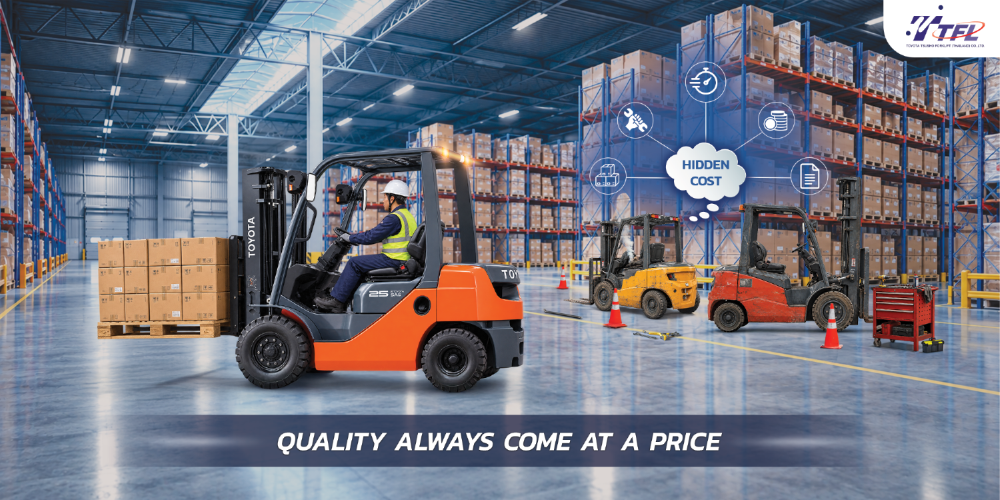
This is the hardest cost to predict and often the one that blows the budget. Some low-cost forklifts use non-standard components; when they fail, spare parts have to be ordered from overseas, taking weeks to arrive — and the parts themselves aren’t as cheap as you might hope.
By contrast, forklifts from brands with local parts inventory in Thailand can be repaired within days, cutting both repair costs and lost time.
4. Downtime Cost — The Invisible Bill
The most damaging “hidden” cost is the time your forklift spends waiting for repairs. Think about how many pallets your forklift moves in a day. When it’s down for a day, that volume of goods doesn’t ship, orders are delayed, and customers feel the impact.
|
Example: Calculating Downtime Cost Assume one forklift generates output worth roughly THB 10,000–20,000 per day. |
5. Operator Training and Safety Costs
Ergonomically designed forklifts equipped with operator-assist features — rollover-prevention systems, cornering speed control, easy-to-read displays — shorten new-operator training time and reduce the risk of accidents.
Even a single forklift accident can mean medical costs, property damage, halted production, and legal liability. All of these are costs you can prevent starting at the buying decision.
6. Resale Value
Forklifts aren’t disposable assets. At end of life, machines from trusted brands with strong maintenance records sell on for significantly higher prices.
Resale value is effectively a “rebate” that lowers your total cost of ownership. A forklift with a higher purchase price but strong resale value can have a lower real cost than a cheap forklift with almost no secondhand market.
A Simple Way to Calculate TCO
Before comparing forklifts from different brands, try this rough formula to estimate the true total cost.
|
TCO = Purchase Price + (Energy/year × years) + (PM/year × years) + Avg. Emergency Repairs − Resale Value |
For instance, if you plan on a 5-year life cycle, estimate each cost category and add them up. A forklift with a purchase price THB 100,000 higher — but that saves THB 30,000/year on fuel, THB 20,000/year on repairs, and returns THB 80,000 more at resale — ends up THB 230,000 cheaper over its working life.
TCO Comparison Checklist
- Ask sellers for fuel or electricity cost per operating hour
- Ask about PM intervals and cost per service visit
- Check whether parts are stocked locally and typical delivery time
- Ask about warranty terms and after-sales service agreements
- Research resale prices in the used-forklift market
Why Toyota Forklift Delivers Long-Term Value
Toyota has been the world’s leading forklift manufacturer for years — and the main reason isn’t the cheapest price. It’s a lower total cost of ownership compared with forklifts in the same class.
The Toyota System of Active Stability (SAS) enhances stability while lifting and moving, reducing the risk of tip-overs — which directly cuts training costs and accident-related expenses. Meanwhile, a nationwide service network and genuine parts stocked in Thailand get your forklift back to work quickly, minimizing downtime.
Toyota Forklift also enjoys strong recognition in the used market, so when it’s time to change equipment, you keep more of your investment. These factors together give Toyota Forklift a highly competitive TCO.
Summary: Compare Real Costs, Not Just the Sticker
The purchase price is only the starting point. Whether this investment pays off depends on the total cost of ownership — fuel, maintenance, repairs, downtime, and resale value included.
Before you sign for your next forklift, use the checklist above to compare brands — you’ll see the real cost picture clearly. Contact Toyota Tsusho Forklift (Thailand) for a quote with a long-term cost assessment tailored to your actual operation.


