 News & CSR
 Branches
 Contact Us
 Join Us
 Service Complaints
 Customer Portal
Electric Forklift vs Diesel Forklift: What Are the Differences? (Diesel VS Electric)
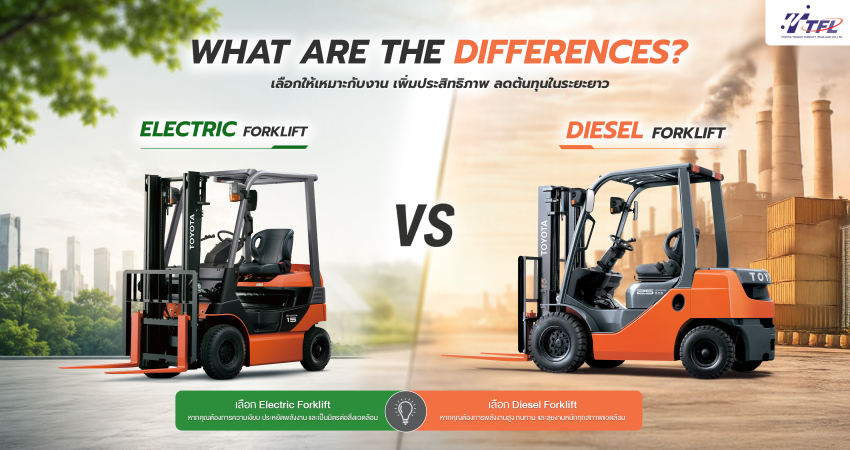
One of the most common questions our customers ask the Toyota Tsusho Forklift (Thailand) team is:
"Should I choose an electric forklift or a diesel forklift?"
While both types of forklifts serve the same purpose—lifting, transporting, and storing materials—their operating costs, performance, working environments, and maintenance requirements differ significantly.
In this article, we compare the advantages, limitations, and ideal applications of electric and diesel forklifts to help businesses make the right investment for their material handling operations.
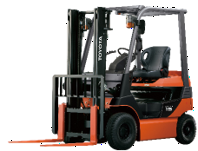
What Is an Electric Forklift? |
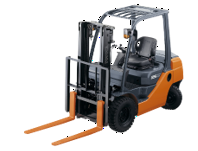
What Is a Diesel Forklift? |
|
|
|
An electric forklift is powered by a rechargeable battery instead of an internal combustion engine. Since it produces no exhaust emissions during operation, it is an ideal solution for indoor warehouses and facilities that require a clean and environmentally friendly working environment. |
A diesel forklift is powered by a diesel engine, providing strong torque and reliable performance for heavy-duty applications. Diesel forklifts are designed to handle demanding workloads and continuous operations, especially in outdoor environments. |
Key Advantages |
|
|
Electric Forklifts:
|
Diesel Forklifts:
|
Ideal Applications |
|
|
Electric forklifts are commonly used in:
|
Diesel forklifts are commonly used in:
|
Electric Forklift vs Diesel Forklift: Side-by-Side Comparison
|
Feature |
Electric Forklift |
Diesel Forklift |
|---|---|---|
| Power Source | Battery | Diesel Fuel |
| Noise Level | Low | Higher |
| Emissions | Zero Exhaust Emissions | Produces Exhaust Emissions |
| Energy Cost | Lower | Higher |
| Maintenance Cost | Lower | Higher |
| Indoor Applications | Excellent | Limited |
| Outdoor Applications | Suitable | Excellent |
| Heavy-Duty Operations | Good | Excellent |
| Continuous Operation | Depends on Battery Capacity | Quick Refueling and Immediate Operation |
Long-Term Cost: Are Electric Forklifts More Cost-Effective?
Although electric forklifts may have a higher initial purchase price in some cases, they often provide a lower Total Cost of Ownership (TCO) over their lifetime.
The reasons include:
- Lower energy costs compared to diesel fuel
- No engine oil replacement
- No exhaust treatment systems
- Fewer moving mechanical components
- Reduced maintenance and service requirements
For businesses operating forklifts daily, evaluating the total lifecycle cost is often more important than focusing solely on the initial purchase price.
At Toyota Tsusho Forklift (Thailand), we can provide customized TCO calculations to help customers compare operating costs and make informed investment decisions.
When Should You Choose an Electric Forklift?
An electric forklift may be the best choice if your business:
- Primarily operates indoors
- Runs multiple shifts per day
- Wants to reduce energy expenses
- Aims to lower carbon emissions
- Has ESG, sustainability, or carbon reduction objectives
As more companies move toward greener operations, electric forklifts are becoming an increasingly popular solution for modern warehouse and logistics environments.
When Should You Choose a Diesel Forklift?
A diesel forklift remains an excellent choice for businesses that require:
- Heavy-duty lifting on a regular basis
- Outdoor operations
- Container yard, Ports and terminals.
- Continuous operation over long working hours
- Fast refueling with minimal downtime
- Work environments where charging infrastructure is not yet available
Toyota Tsusho Forklift (Thailand) Recommendation
Currently, many organizations are transitioning from diesel forklifts to electric forklifts to reduce operating costs and support their sustainability goals.
However, there is no single forklift solution that fits every business.
The right choice depends on several factors, including:
- Load capacity requirements
- Working environment
- Operating hours
- Facility infrastructure
- Energy costs
- Long-term business objectives
At Toyota Tsusho Forklift (Thailand), our material handling specialists are ready to evaluate your operation and recommend the most suitable forklift solution for your business.
Whether you are looking for an electric forklift for warehouse operations or a diesel forklift for heavy-duty outdoor applications, our team can help you optimize productivity, efficiency, and total ownership costs.


