 News & CSR
 Branches
 Contact Us
 Join Us
 Service Complaints
 Customer Portal
Buy or Rent a Forklift: How to Choose the Right Option for Your Business
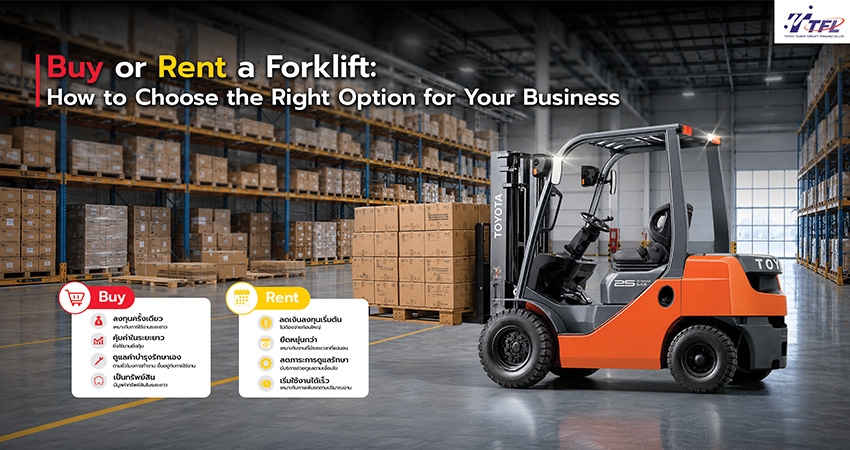
When a business needs a forklift, one of the first big questions is whether to buy or rent. Both options have their advantages, and the decision shouldn’t come down to upfront cost alone. Length of use, usage frequency, maintenance capacity, and business flexibility all matter.
Buying a Forklift — Who It’s Right For
Buying a forklift makes sense for businesses with clear, ongoing needs — especially those that fit this profile:
- Uses a forklift every day as part of daily operations
- Has continuous, long-term demand
- Has a stable workflow that doesn’t change often
- Wants to own the asset and record it on the balance sheet
- Has an in-house team or is ready to handle maintenance costs
In terms of value, buying may have a higher upfront cost, but if the forklift runs continuously for several years, the average monthly cost can be lower than renting — with the added freedom of unrestricted use, without contract time limits.
Renting a Forklift — Who It’s Right For
Renting is a good match for businesses that value flexibility and want to keep capital investment down — particularly those with these characteristics:
- Uses a forklift only during specific periods, not year-round
- Runs project-based or seasonal work, such as high season
- Has variable demand that rises and falls over time
- Wants to avoid a large upfront outlay or preserve liquidity
- Wants to offload repair and maintenance burdens
- Needs to swap models or adjust fleet size for different jobs
Renting makes budgeting more predictable, removes the burden of ownership, and — depending on the contract — may include maintenance or breakdown coverage. That frees you up to focus on your core operations.
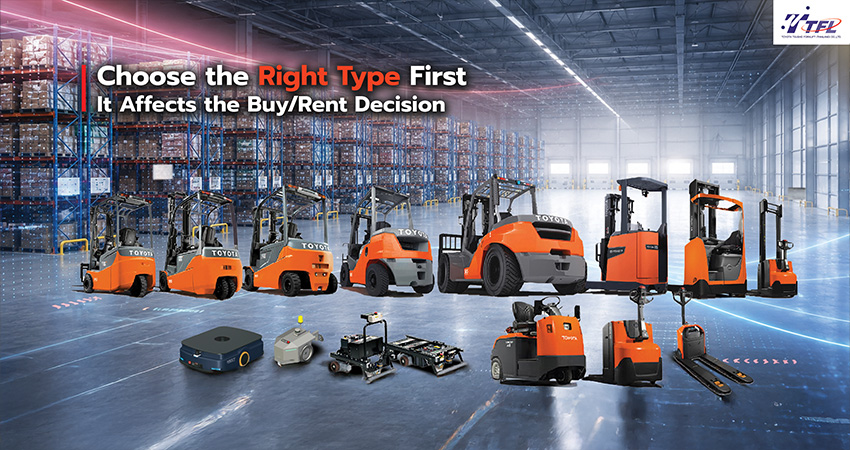
Choose the Right Type First — It Affects the Buy/Rent Decision
Before deciding whether to buy or rent, it’s important to know which forklift type fits your work. Each type comes with different cost profiles and usage patterns — which directly influences the most cost-effective ownership model.
| Type | Best suited for | Buy/Rent implication |
| Counterbalance | General warehouse work; lifting pallets and boxes in open space | Buy if used daily / rent for occasional use |
| Reach Truck | High-rack storage (8–12 m); narrow aisles | Rent if usage isn’t daily — high purchase cost |
| Pallet Truck | Short-distance pallet movement; no lifting height | Low cost to buy, quick payback |
| Stacker | Rack loading; tight spaces; mid-sized warehouses | Renting works well when demand is variable |
Power Type — How It Affects the Buy/Rent Decision
- Electric: quiet, efficient, ideal indoors. Low long-term energy cost → buy if used daily
- Diesel: powerful, durable, ideal outdoors. Higher fuel cost → rent for project-based use
- LPG: flexible for both indoor/outdoor use, fast refueling → either buy or rent based on workload
Businesses that need to alternate between different forklift types often find renting more flexible — you can switch models based on the job at hand without having to buy multiple machines.
Buy vs Rent: A Side-by-Side Comparison
| Aspect | Buy | Rent |
| Upfront investment | Higher | Lower |
| Long-term value | Best for continuous use | Best for short-term or variable use |
| Maintenance | Buyer’s responsibility | Often included in contract |
| Flexibility | Harder to swap machines | Easy to change model or quantity |
| Ownership | Company asset | No asset at end of contract |
| Ease of use | Self-managed | Reduced maintenance burden |
Questions to Ask Before You Decide
Before choosing between buying and renting, answer these questions honestly. The clearer your answers, the sharper your decision.
On duration and usage frequency
- How long will you need the forklift — months or years?
- Will it be used daily or only periodically?
- How many operating hours per day?
- Is demand stable, or does it fluctuate by season?
On work type and workspace
- What is the maximum load weight you need to lift? (Choose capacity 10–20% above actual needs)
- How wide is your workspace? Indoor or outdoor use?
- What lift height do you need — standard (3–6 m) or high-rack (8–12 m+)?
- Do you need to alternate between forklift types?
On budget and management
- Does the business have upfront capital, or would you rather preserve liquidity?
- Do you have an in-house maintenance team?
- Are you planning to scale up — which could change your fleet needs?
- Will you frequently swap models based on job type?
Common Mistakes — and How to Avoid Them
Based on experience advising a wide range of customers, these are the mistakes we see most often when businesses choose to buy or rent a forklift.
- Choosing purely on lowest price — without considering TCO. Cheap forklifts often carry higher repair and downtime costs, driving up total long-term expense.
- Ignoring the workspace — forklifts that are too big or too small hurt both efficiency and safety.
- Choosing capacity that’s too low — pick a machine that handles 10–20% more than your actual load for operator safety.
- Buying without a long-term plan — if your business is scaling up, renting early on may be more flexible and cost-effective.
- Renting without checking contract terms — confirm what maintenance is covered and how breakdowns are handled.
💡 Tip from Toyota Tsusho Forklift (Thailand)
When you’re unsure whether to buy or rent, use daily operating hours as the primary guide:
→ Less than 4 hours/day → consider buying (With lower usage hours, a Toyota forklift can offer strong resale value when resold.)
→ More than 6 hours/day → consider renting (Contact Toyota Forklift today to receive a special rental offer!)
Summary
There’s no single right answer to buying or renting — it depends on how you use the forklift and what your business is trying to achieve.
|
🔵 Buy when...
🔴 Rent when...
|
Before deciding, evaluate your operational needs, usage period, and budget in full. Toyota Tsusho Forklift (Thailand) experts can help you choose the ownership model that fits your real-world usage.


