 News & CSR
 Branches
 Contact Us
 Join Us
 Service Complaints
 Customer Portal
Forklift Operator Certification in Thailand: Is It Required by Law? Where to Get Trained?
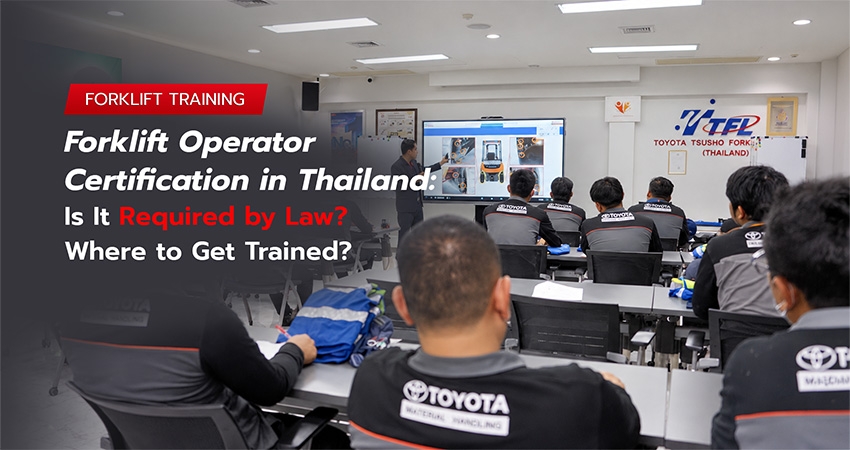
Many factories and warehouses still have employees operating forklifts without any formal training — thinking that "knowing how to drive is enough." The real cost only shows up when something unexpected happens: an accident the insurance refuses to cover, a surprise inspection by labour authorities, or a customer rejecting the factory in a safety audit.
This article answers the three questions business owners ask most: What is a forklift operator certification? Does Thai law require it? And if training is needed, how do you choose the right training center?
What Is a Forklift Operator Certification?
A Forklift Operator Certification is a document issued to employees who have passed training and assessment under a legally recognized curriculum. It confirms that the operator has the knowledge and skills to operate a forklift safely.
There are generally two main types:
-
Operator Certification — for the direct operator, focused on handling and control of the forklift
-
Safety Training — focused on workplace safety, suitable for supervisors and site managers
Under current Thai law, forklift operator certifications do not have a formal expiry date. However, TTFL offers refresher courses for individuals and organizations interested in both theoretical and practical knowledge updates — reinforcing a safety-first mindset for forklift operators throughout their working life.
Is It Required by Thai Law? — Straight Answer
Yes, it is required. Thailand has clear regulations requiring employers to provide training for employees who will serve as forklift operators before they begin work.
The key regulations include:
-
Notification of the Department of Labour Protection and Welfare on “Training Curriculum for Employees Who Will Serve as Forklift Operators,” published in the Royal Thai Government Gazette on 17 January B.E. 2568 (2025) and in force from 18 January B.E. 2568 (2025) onwards.
-
Ministerial Regulation on Standards for Administration, Management, and Operation of Safety, Occupational Health, and Working Environment Related to Machinery, Cranes, and Boilers B.E. 2564 (2021) — requires employers to arrange training for employees who will serve as forklift operators, covering the use of each type of forklift, safe operation, inspection, and maintenance, delivered by instructors with the knowledge, expertise, and experience in forklift operation under the curriculum prescribed by the Director-General.
Failure to comply with these requirements constitutes a breach of the safety standards set out in the ministerial regulation under the Occupational Safety, Health, and Environment Act B.E. 2554 (2011), and is subject to penalties.
In short: employers must train forklift operators before they start work. Failure to do so can carry a penalty of up to 1 year of imprisonment and/or a fine of up to THB 400,000.
Legal note: The information in this article is for general understanding only. Before making decisions or taking action based on these requirements, we recommend verifying details with your company’s legal team or contacting the Department of Labour Protection and Welfare in your area.
Risks of Operating Without Certification
Many businesses mistakenly see skipping certification as "saving on training costs," but the hidden costs run deep:
- Insurance may deny coverage — If an accident occurs, insurance coverage may be affected depending on the terms and conditions of the policy, particularly if the forklift operator does not have proof of training or the required qualifications.
- Legal penalties — when a factory inspection finds that employees have not been trained, the employer faces prosecution and fines
- Failed customer audits — export-oriented factories (automotive, electronics) typically run safety audits. Uncertified operators can cost you major clients
- Criminal liability for injury or death — the employer bears direct responsibility
- Vehicle and goods damage — untrained operators lack knowledge of proper vehicle care and correct operation, leading to extra repair costs, damage from misuse, and additional operating expenses — far more than for trained operators
What’s in the Training Curriculum?
Forklift training courses that meet Department of Labour Protection and Welfare standards typically take 1–2 days (6–12 hours, per the official curriculum), split into two main parts:
Theory (approximately 6 hours)
- Safety laws and regulations on liquefied petroleum gas (LPG) use for forklifts
- Introduction to forklift types by use case
- Structure, components, accessories, and maintenance by forklift type
- Safe operation and relevant workplace rules and regulations
- Accident analysis and prevention
Practical (approximately 6 hours)
- Forward and reverse driving
- Lifting and placing loads at various heights
- Turning in tight spaces
- Braking and parking
- Practical assessment and course summary
Once both sections are passed, trainees receive a “Certificate of Completion for Forklift Operation Safety Training,” which serves as proof of completed forklift training. You can view the TTFL forklift training courses at www.toyotaforkliftthailand.com/training.php

Where to Get Trained — Comparing Your Options
There are several training centers available in Thailand. Choose based on your budget, convenience, and the recognition you need.
| Channel | Cost | Teaching Quality | On-Site Training | Recognition |
| Private training centers | Low–Mid | Varies by provider | Depends on provider | Moderate |
| Government-affiliated institutes | Low | Standard curriculum | Rarely offered, long queue | High |
| Brand-authorized dealer (TTFL Training) | Mid–High | Expert instructors on actual models | Can be arranged at your site | High |
For brand-authorized dealers such as TTFL Training, the main advantage is that instructors are specialists deeply familiar with Toyota forklifts. They can arrange training at your facility, reducing employee travel time, while providing training programs designed to comply with applicable Thai regulations and industry safety practices.
Employee Qualifications Before Training
To help your employees pass training smoothly, make sure the following requirements are met:
- 18 years of age or older, as required by labour law
- Physically fit, with normal vision, hearing, and general health for operating machinery
- No medical conditions that could affect vehicle control (e.g., epilepsy)
- Ready to attend 1–2 days of theory and practical training (per the course duration specified)
- For corporate clients, we provide full procedural and documentation support for submission to the Department of Labour Protection and Welfare
Tip from Toyota Tsusho Forklift (Thailand)
Plan your training for maximum value: Send multiple employees to the same course batch — cost per person drops significantly. And if traveling to TTFL isn’t convenient, you can request on-site training at your facility, using your own forklifts as teaching tools so employees train on the exact machines they’ll operate in real work.
Summary — Certification Is a Worthwhile Investment
Forklift operator certification isn’t a "cost to avoid" — it’s a "safety investment" that helps your business:
- Stay compliant with Thai law, with no worries about inspections or fines
- Reduce and prevent accidents and various damage costs
- Pass customer safety audits
- Build a confident, more efficient workforce
Toyota Tsusho Forklift (Thailand) operates TTFL Training with courses covering Operator Training, Safety Training, and Daily Maintenance — built to meet every business need. Our instructors are engineers with direct experience on all Toyota forklift models, and we offer on-site training at your facility.
For more information, contact us at 038-454-428 ext. 155, 156, 157, 222


